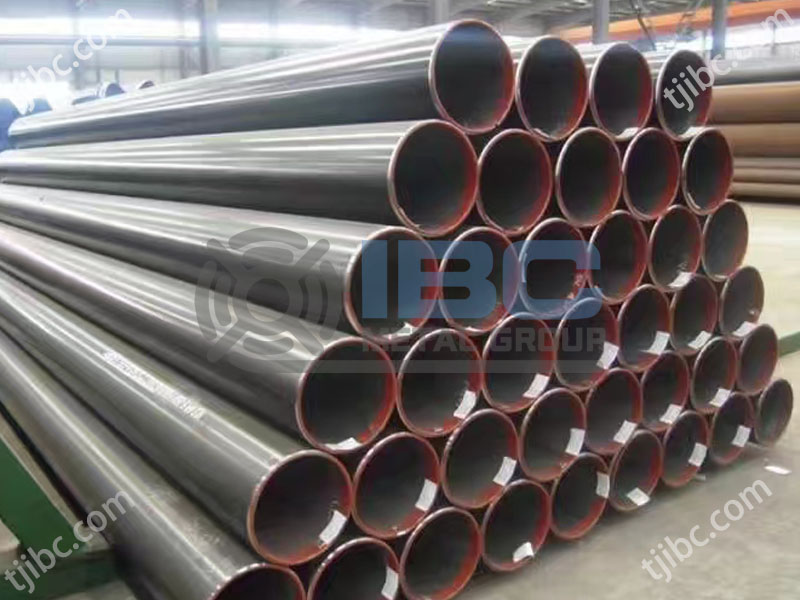
Selecting the correct structural steel pipe is a fundamental engineering decision impacting safety, cost, and compliance. Faced with multiple ASTM standards like A53, A500, and A519, professionals often grapple with a key question: which one is right for my project? This guide cuts through the confusion, providing a clear, technical comparison to empower your material selection.
Decoding the Standards: Purpose Defines Choice
Each ASTM standard serves a distinct purpose. Understanding this is the first step to choosing the right structural steel pipe.
ASTM A53: The Versatile General-Purpose Pipe
ASTM A53 is the benchmark for general-purpose steel pipe. It covers both seamless (Type S) and welded (Type E, Electric-Resistance Welded; Type F, Furnace-Welded) pipes, primarily used for low-pressure fluid conveyance and general structural applications.

Key Characteristics:
Application: Plumbing, low-pressure steam, air, water lines, and non-critical structural supports.
Grades: Grade A (lower strength) and Grade B (higher strength).
Notable Point: While used structurally, it is not specifically engineered for optimal performance in major load-bearing frameworks compared to A500.
ASTM A500: The Engineered Structural Champion
ASTM A500 is the definitive standard for cold-formed welded and seamless carbon steel structural tubing. Its chemical composition and mechanical properties are optimized for load-bearing members in construction.

Key Characteristics:
Application: Primary structural frames for buildings, bridges, stadiums, and space frames.
Grades: Grade B (Minimum Yield Strength 42 ksi / 290 MPa) and Grade C (Minimum Yield Strength 50 ksi / 345 MPa). Grade C offers higher strength for demanding applications.
Notable Point: It is the preferred and often specified choice for modern architectural and structural engineering due to its predictable performance under load.
ASTM A519: The Precision Mechanical Tubing
ASTM A519 covers seamless carbon and alloy steel mechanical tubing. Its focus is on dimensional accuracy, superior surface finish, and uniform mechanical properties for machining and fabrication.

Key Characteristics:
Application: Manufacturing of machine parts, hydraulic cylinders, bearings, and automotive components—where the tube itself is machined or heavily fabricated.
Grades: Multiple carbon and alloy steel grades (e.g., 1020, 4130) with specified chemical analyses.
Notable Point: It is not typically used as a standalone structural element but as a raw material for manufactured parts.
Head-to-Head Comparison: ASTM A53 vs A500 vs A519
The table below provides a concise technical snapshot to guide your initial screening.
| Feature | ASTM A53 | ASTM A500 | ASTM A519 |
|---|---|---|---|
| Primary Scope | General Purpose, Pressure & Structural | Structural Tubing | Mechanical Tubing |
| Common Process | Seamless & Welded | Seamless & Welded (Cold-Formed) | Seamless |
| Key Selection Driver | Versatility, Cost for Non-Critical Uses | Yield Strength, Structural Integrity | Dimensional Accuracy, Machinability |
| Typical Applications | Fencing, Scaffolding, Low-Pressure Lines | Building Frames, Bridges, Structural Supports | Machine Parts, Shafts, Hydraulic Cylinders |
| Critical Metric | Pressure Rating, Weldability | Minimum Yield Strength (Grade B/C) | Chemical Analysis, Hardness |
5-Step Selection Guide for Your Project
Follow this decision framework to navigate the choice between A53, A500, and A519 steel pipe.
- Define the Primary Function.
- Is it a load-bearing structural member (e.g., column, truss)? → Start with ASTM A500.
- Is it for fluid conveyance or general support? → ASTM A53 may be sufficient.
- Will it be machined into a component? → Consider ASTM A519.
- Determine the Mechanical Load.
- Calculate the required yield strength. For significant loads, A500 Grade C (50 ksi yield) provides a higher safety margin than A500 Grade B (42 ksi yield) or A53 Grade B (35 ksi yield).
- Assess Fabrication Needs.
- For welding and erection on-site, both A53 and A500 offer excellent weldability. A500’s consistency is preferred for critical structural welds.
- For precision machining, turning, or drilling, the homogeneity and surface finish of A519 tubing are superior.
- Verify Compliance and Certification.
- Insist on a valid Mill Test Certificate (MTC) that confirms the steel pipe meets all chemical and mechanical requirements of the chosen ASTM standard. This is non-negotiable for structural integrity.
- Consult with a Technical Specialist.
- When in doubt, leverage expert knowledge. A qualified supplier can review your design drawings and application specifics to recommend the most cost-effective and compliant structural steel pipe.
Why Partner with IBC Group for Your Structural Steel?
Navigating ASTM standards requires more than just a product catalog; it demands expertise. At IBC Group, we provide:
- Technical Guidance: We help you decode specifications and select the optimal A53, A500, or A519 steel pipe for performance and budget.
- Assured Compliance: We back every shipment with traceable documentation, including MTCs, to ensure your project meets all regulatory and engineering standards.
- Full-Scale Solution: From seamless pipe to welded structural tubing, we supply the full spectrum of carbon steel pipe for any project scope.
Ready to Specify with Confidence?
[Contact our structural steel specialists today] for a detailed consultation. Send us your project requirements or drawings, and we will provide a compliant material recommendation and a competitive quote for your ASTM structural steel pipe needs.
Contact with us today!