Unlock the secrets of high-strength shipbuilding steel grades. Choosing between Bureau Veritas (BV) certified AH32 and DH32 isn’t just a checkbox exercise – it’s a fundamental decision impacting vessel safety, operational envelope, and structural integrity, especially when temperatures plummet. This in-depth technical guide cuts through the confusion, revealing the crucial differences that dictate performance in icy waters versus temperate seas.
Core Distinction: The Temperature Imperative
The paramount difference between shipbuilding steel BV Grade AH32 and BV DH32 lies in their designed service temperature and, consequently, their guaranteed toughness at low temperatures.

BV Grade AH32: Engineered as a “Normal Strength” Grade for Standard Temperate Service. Its impact toughness is certified at 0°C (32°F). This is the workhorse grade for the majority of vessels operating in routes where seawater and ambient air temperatures reliably stay above freezing.
BV Grade DH32: Classified as a “Higher Strength” Grade with Enhanced Low-Temperature Toughness. Its impact toughness is rigorously tested and certified at -20°C (-4°F). This grade is the essential armor for vessels braving Arctic passages, the North Atlantic in winter, or any environment where exposure to sub-zero temperatures is expected.
Key Takeaway: DH32 isn’t “stronger” than AH32 at room temperature; it’s significantly tougher when it gets dangerously cold. This toughness is the critical barrier against brittle fracture – a sudden, catastrophic failure mode with little to no plastic deformation.
Quantifying Toughness: The Charpy V-Notch Test
The definitive measure separating AH32 and DH32 is the Charpy V-Notch (CVN) Impact Test. This test quantifies the energy absorbed by a material during fracture under specified conditions.

BV AH32 Requirement: Charpy impact testing is performed at 0°C (32°F). The standard requirement (referencing BV NR216 rules or equivalent IACS unified requirements) typically mandates that the average energy of three specimens meets or exceeds 34 Joules (J), and no single specimen falls below a specified minimum (often around 24J or 80% of the average, depending on the exact rule and plate thickness).
BV DH32 Requirement: Charpy impact testing is performed at the significantly lower temperature of -20°C (-4°F). Despite the harsher condition, it must meet the same minimum energy absorption standards (e.g., avg ≥ 34J, single min threshold) as AH32 does at 0°C.
Engineering Significance: Achieving the same energy absorption at -20°C demands a fundamentally different material structure and purity than achieving it at 0°C. DH32’s microstructure is optimized to resist crack initiation and propagation under severe thermal stress.
Mechanical Properties: Strength Parity, Toughness Divergence
Despite the critical toughness difference, AH32 and DH32 share identical minimum strength requirements at ambient temperature:
Yield Strength (ReH min): 315 MPa (45,700 psi) for both grades. (The “32” denotes this minimum yield strength).
Tensile Strength (Rm): 440 MPa (63,800 psi) to 590 MPa (85,600 psi) for both grades.
Elongation (A5 min): Typically ≥ 22% (varies slightly with thickness for both grades).
Implication: At room temperature, plates of AH32 and DH32 will exhibit very similar strength characteristics under load. The difference only becomes critically apparent when the structure is subjected to impact loading or stress concentrations in a cold environment.
Manufacturing Process: Precision for Performance
Achieving DH32’s demanding -20°C toughness consistently requires more sophisticated manufacturing than AH32:
Refined Steelmaking: Deeper desulfurization (e.g., ladle furnace treatment) and degassing to achieve ultra-low P and S levels. Precise alloy addition control.
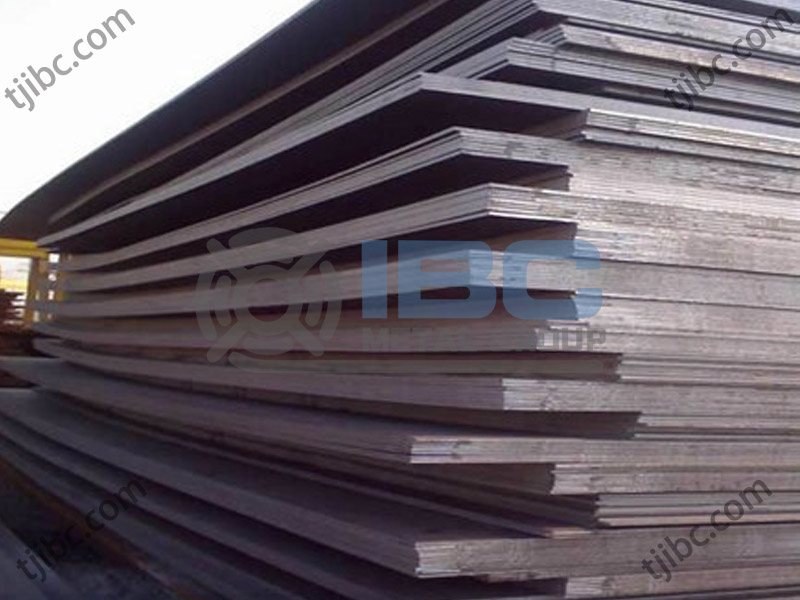
Thermo-Mechanical Controlled Processing (TMCP): This is the dominant modern method. Involves strictly controlled rolling temperatures, deformation amounts per pass, and accelerated cooling rates. This produces a very fine-grained ferritic microstructure, often with beneficial bainitic components, maximizing toughness.

Normalizing (N): An alternative or supplementary process. The plate is heated above its critical temperature and cooled in air. This refines the grain structure and improves homogeneity and toughness. DH32 may require specific normalizing practices or be produced via TMCP followed by tempering depending on thickness and mill capability.
Enhanced Quality Control: More rigorous testing protocols throughout production, including stringent ultrasonic testing (UT) for internal defects.
Production Reality: While high-quality AH32 also uses TMCP or normalizing, DH32 pushes the boundaries of process control and consistency required to hit the -20°C toughness target reliably across entire shipbuilding steel plate batches.
Application Scenarios: Matching Grade to Environment
BV Grade AH32 is Essential For:
Bulk carriers, tankers, container ships operating primarily in tropical and temperate zones (e.g., Asia-Europe, Trans-Pacific south routes).
Internal structures within the cargo hold/main hull where temperatures remain moderated.
Superstructures above the main deck (depending on specific vessel design and route).
Ship components not exposed to the most severe cold or impact loads.
Barges and coastal vessels operating in mild climates.

BV Grade DH32 is Essential For:
Ice-class vessels (e.g., Ice Class 1A, 1A Super).
Vessels operating in Arctic or Antarctic waters (Northern Sea Route, Northwest Passage, Antarctic supply).
Ships navigating the North Atlantic, Baltic Sea, or Sea of Japan during winter months.
Exposed critical areas on any vessel operating in potential sub-zero temperatures:
Sheer Strake & Stringer Plate (Top of the hull side, critical for longitudinal strength).
Deck Plating (Exposed to cold air, wave impact, cargo handling).
Bilge Strake (Subject to high stress concentrations).
Forecastle Deck & Bow Thruster Zones (High impact loads from waves).
Structures adjacent to LNG/LPG cargo tanks (secondary barrier areas) where cold temperatures can permeate (Direct containment requires even higher grades like EH36/FH36).
Offshore structures in cold environments (e.g., North Sea platforms, Arctic modules).
Cost Considerations
Generally, shipbuilding steel BV DH32 commands a premium over BV AH32. This reflects:
Tighter Chemistry Control: Costs of deeper desulfurization/deoxidation and precise alloying.
Advanced Processing: TMCP requires sophisticated mill equipment and precise control systems. Normalizing consumes significant energy.
Enhanced Testing & Certification: More rigorous quality checks and oversight.
Lower Production Yield: Stricter internal rejection criteria for borderline heats/plates.
Value Proposition: The premium for DH32 is an investment in safety, operational capability in harsh environments, regulatory compliance, and reduced risk of costly in-service failures or detentions. For vessels operating exclusively in warm waters, AH32 provides excellent value.
Conclusion: AH32 vs. DH32 – A Decision Driven by Design Temperature
BV AH32 and BV DH32 are both crucial high-strength shipbuilding steels (315 MPa Yield). Their fundamental difference is not strength at ambient temperature, but guaranteed toughness at low temperatures:
Choose BV AH32: For vessels operating reliably in environments above 0°C (32°F), where its certified 0°C toughness provides robust and cost-effective performance for hull structures.

Mandate BV DH32: For any structure exposed to potential sub-zero temperatures (down to -20°C / -4°F), especially on vessels in cold oceans, ice zones, or carrying cryogenic cargoes nearby. Its certified -20°C toughness is the critical safeguard against brittle fracture.
Contact with us today!