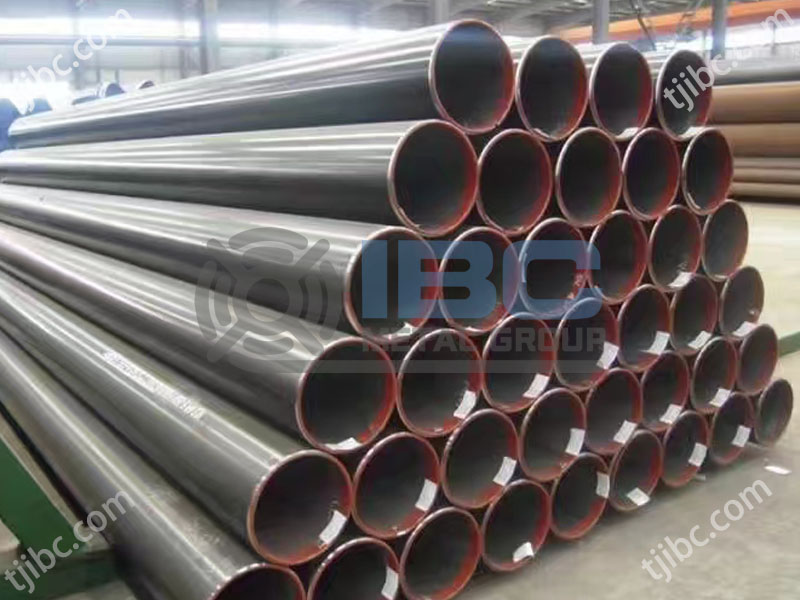
Demanding pipeline projects require steel pipes that combine precision geometry, consistent mechanical properties, and structural integrity. UOE pipe manufacturing achieves this through a controlled four-stage forming process. Unlike conventional welding methods, the UOE technique transforms heavy steel plates into dimensionally optimized pipes ready for extreme operating conditions.
The Precision Forming Process
Operators first crimp plate edges to prepare for curvature formation. Hydraulic presses then shape the steel through sequential U-forming (creating a U-profile) and O-forming (closing into a near-perfect circle). This staged deformation minimizes stress concentrations in the final product.
After longitudinal submerged arc welding (SAW) seals the seam, the critical expansion stage begins.

Here, internal mandrels radially expand the pipe by 0.8-1.5% of its diameter. This cold-working operation achieves three objectives:
- Precise dimensional tolerances (±0.5% diameter)
- Uniform circumferential yield strength
- Elimination of residual stresses from prior forming stages
Technical Superiority in Performance
UOE pipes typically comply with API 5L/ISO 3183 standards for pipeline transportation systems. Their metallurgical properties outperform alternatives in critical applications:
| Property | Typical UOE Pipe Range | Advantage vs. ERW Pipe |
| Yield Strength | 360-555 MPa (Grade X80) | 15-20% higher consistency |
| Tensile Strength | 460-690 MPa | Better strain hardening |
| Charpy V-Impact | 200-300 J (-20°C) | Superior fracture toughness |
| Diameter Tolerance | ±0.5% | Tighter ovality control |
| Wall Thickness | 10-40 mm | Heavy-duty capability |
*Table 1: Key mechanical properties of API 5L-grade UOE pipes*
The process accommodates diameters from 406mm to 1,422mm, with wall thickness capabilities reaching 40mm for deep-water applications. Chemical composition typically features low-carbon steels (C≤0.12%) with microalloying elements like niobium and vanadium to enhance strength through grain refinement.
Material Science Foundations
UOE pipes derive their reliability from controlled chemistry and thermomechanical processing. Standard grades like X70-X80 utilize:
- Carbon Equivalents (Ceq): 0.38-0.45% for optimal weldability
- Sulphur/Phosphorus: ≤0.005% to minimize segregation
- Controlled rolling temperatures (850-880°C) preserve toughness

The expansion phase induces beneficial work hardening, increasing yield strength by approximately 5% while maintaining elongation above 18%. This strain-aging effect contributes to the characteristic stress-strain curve plateau observed in UOE pipe tensile tests.
Real-World Performance Validation
In the Trans-Anatolian Pipeline, X70 UOE pipes with 1,067mm diameter sustained 11.8 MPa operating pressures across seismic zones. Similarly, offshore Brazil’s pre-salt fields use 30mm-wall UOE pipes rated for 3,500m water depth. Such projects validate the method’s capacity to maintain dimensional stability under external hydrostatic pressure exceeding 35 MPa.
Why Engineers Specify UOE Technology
Three technical factors drive selection for critical infrastructure:
Collapse resistance: Ovality below 0.6% prevents buckling in offshore applications
Weld integrity: SAW produces through-thickness fusion impossible with spiral welding
Material economy: Achieves high pressure ratings with 8-12% less wall thickness versus seamless alternatives
Conclusion
The UOE pipe manufacturing process delivers geometrically precise, metallurgically optimized pipelines for energy transportation challenges. Its controlled forming stages produce unmatched dimensional consistency and mechanical properties, particularly for large-diameter, high-pressure applications.

When project specifications demand guaranteed material performance under extreme loads, this engineered solution provides measurable operational assurance.
Explore our pipeline solutions portfolio or request technical specifications for your next project.
Contact with us today!